

 See My Latest Article on HelloNation
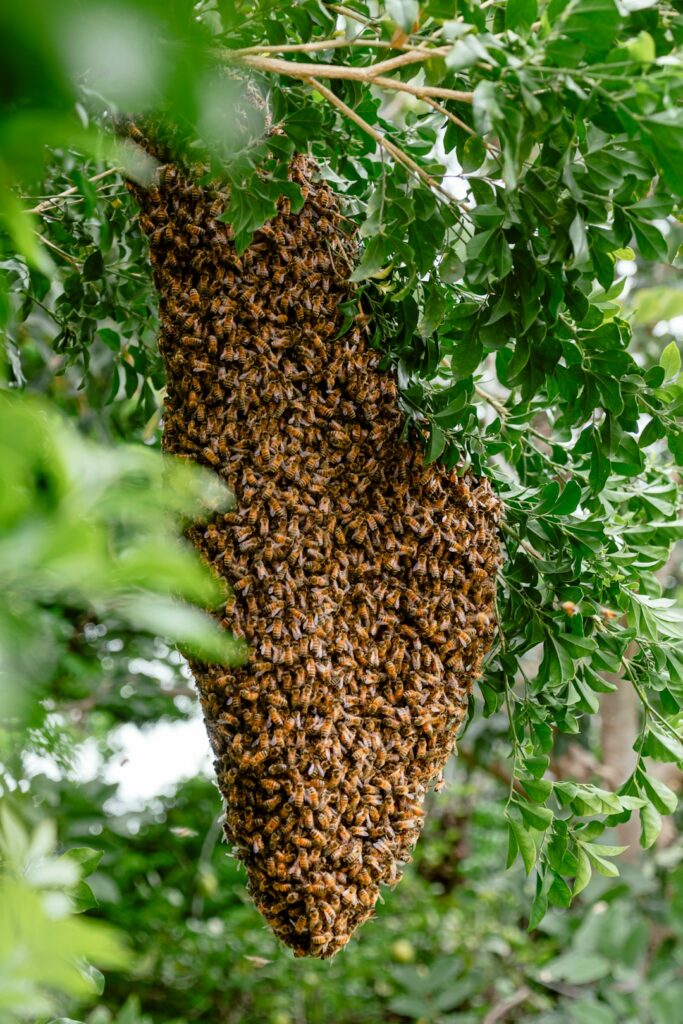
A cluster of honey bees on a tree branch can look alarming, but it may be a temporary swarm rather than a permanent nest. The difference matters because a swarm may move on within hours or days, while an established colony can remain in a wall, roof void, utility box, or other cavity and continue growing.
The safest way to judge the situation is to observe from a distance. Do not shake the branch, block an entrance, spray the bees, or open a wall to investigate.
What is a honey bee swarm?
A swarm is a group of bees that has separated from an existing colony and is temporarily searching for a new nesting site. The bees often gather around a queen and form a dense, living cluster while scout bees look for a suitable cavity.
A swarm may appear as:
- A football-sized or larger cluster hanging from a branch, fence, eave, sign, or shrub
- Thousands of bees covering one visible surface without a clear entrance
- A temporary mass that arrived suddenly
- Bees that are mostly clustered together rather than flying in a steady stream
Swarming is a natural part of honey bee reproduction. The parent colony sends out a queen and many worker bees, leaving another queen or developing queen behind. While a swarm does not yet have stored honey, brood, or established comb to defend, it should still be treated cautiously.
In warm, humid conditions, including those common in Miami, a swarm may settle temporarily in shaded landscaping, beneath an overhang, or near a building while scouts search for a permanent cavity.
What is an established bee colony?
An established colony is a functioning nest with a queen, worker bees, wax comb, brood, pollen, and stored honey. It may be hidden inside a structure or located in a protected outdoor space.
Common locations include:
- Wall voids and soffits
- Roof or attic spaces
- Tree cavities
- Utility or water meter boxes
- Gaps around plumbing, vents, or electrical fixtures
- Vacant containers, sheds, and sheltered building features
The clearest sign is repeated bee traffic through a specific opening. Bees leave the entrance, circle briefly, and return carrying pollen or other materials. On warm days, residents may see a steady stream of movement rather than a single stationary cluster.
A colony may also produce a persistent buzzing sound inside a wall or ceiling. Wax comb, honey staining, or a sweet odor can appear later, but these signs are often hidden until part of the structure is opened.
How can residents tell the difference?
Location and behavior provide useful clues, but no single sign is perfect.
| Sign | Temporary swarm | Established colony |
|—|—|—|
| Typical location | Exposed branch, fence, shrub, or surface | Cavity, wall, roof space, box, or protected enclosure |
| Activity | Dense cluster with limited traffic | Repeated flight in and out of one entrance |
| Pollen collection | Usually absent | Common among foraging workers |
| Wax comb | Usually absent at first | Present, even if hidden |
| Duration | Often hours to a few days | May remain for weeks, months, or longer |
| Defensive behavior | Often less defensive, but not harmless | May be strongly defensive near the nest |
The presence of pollen is especially useful. Established colonies collect pollen to feed developing young. A swarm that has not selected a permanent nest generally has no brood to provision, so visible pollen collection is less likely.
Time is another clue. A cluster that appears on a branch in the morning and disappears later may have been a traveling swarm. Bees that continue using the same hole or cavity day after day are more likely to be an established colony.
Why a cluster is not always harmless
A visible cluster may be the beginning of a colony. If bees have started building comb inside the cluster or behind the surface where they landed, the situation can change quickly.
An exposed nest can also be difficult to classify from the ground. Some honey bees may build in open locations, while others favor cavities. In southern Florida, residents should not assume that an exposed group is automatically docile or that a hidden colony is automatically aggressive.

Defensiveness depends on several factors, including the colony’s genetics, the presence of brood and honey, weather, nearby activity, and whether the bees feel threatened. Repeatedly approaching the cluster, mowing nearby, using power equipment, or trying to remove it can provoke defensive behavior.
What should residents do after finding bees?
Keep people and pets away from the area and observe from a protected location. Close nearby doors and windows if bees are gathering close to the home. Avoid loud equipment, smoke, water, insecticide, and attempts to knock the bees down.
Do not:
- Seal an opening while bees are still inside
- Pour liquid into a wall, tree cavity, or utility box
- Spray a cluster with household chemicals
- Cut into siding, roofing, or drywall
- Try to capture the bees without proper protective equipment
- Rely on color alone to identify the bees or judge their temperament
If anyone has been stung, move indoors or into a vehicle. A person who develops trouble breathing, swelling of the face or throat, dizziness, weakness, or widespread hives needs emergency medical attention. Multiple stings also warrant urgent medical evaluation, especially for children, older adults, and anyone with a known allergy.
Does the removal approach depend on the identification?
Yes. A swarm resting in an exposed location may be collected without opening a structure, provided the situation is safe and the person handling it is properly trained. An established colony is more complicated because the bees, comb, brood, honey, and nesting materials may all need to be addressed.
Simply removing visible bees is not the same as removing a colony. If comb and honey remain inside a wall or roof space, the smell can attract other insects and bees. Leftover materials can also leak, stain building components, or encourage bees to return to the same cavity.
Florida rules also distinguish between live bee removal and pest-control work. Live removal may involve a registered beekeeper, while extermination of a nuisance colony is regulated pest-control activity. Local property rules or building requirements may apply when walls, roofs, trees, or utility structures are involved.
What local conditions can make the problem harder to see?
Dense landscaping, screened porches, flat-roof details, mature trees, and small gaps around utility equipment can provide many potential nesting sites. Warm weather allows honey bee activity during much of the year, so a colony may be active even when residents do not associate the sighting with a traditional spring swarm.
Rain, wind, and changing temperatures can also alter bee movement. Activity may be quiet during poor weather and increase when conditions improve. A lack of visible bees at one moment does not prove that a colony has left.
The most reliable distinction is this: a swarm is usually a temporary cluster with no established nest, while a colony has a fixed entrance, ongoing traffic, and resources such as comb, brood, pollen, or honey. When those signs are unclear, distance and caution are more useful than trying to investigate firsthand.